Drive Your Own Digital Transformation with Dynamics 365, CDM and Power Apps
Note (2025): This post was written in 2017 and reflects the technology landscape at that time. Since then, the Common Data Model platform has evolved into Dataverse (formerly Common Data Service), "Dynamics 365 for Operations" has become D365 Finance & Supply Chain Management, "Project Services Automation" is now D365 Project Operations, and Cortana Intelligence has been replaced by Azure AI services. The architectural principles discussed here remain relevant, but the specific tooling and terminology have changed.
In this post, we continue to explore the Common Data Model (CDM), its roadmap and integration features with Dynamics 365, as well as some examples of how to apply this technology in a variety of service industries (such as IT consulting, legal services, or advertising).
The Common Data Model was designed to be the backbone for all business data across the Dynamics 365 platform and everything that integrates with it. CDM can provide a real-time synchronisation interface with other cloud services through predefined connectors and data gateways. In addition, it comes with a set of tools that allow your power users — the people who understand their business needs best — to build automation, analytics, and apps quickly and without writing code.
The overall solution to deliver what Microsoft calls the "intelligent business cloud" is composed of the following main building blocks:
- Dynamics 365 (with modules such as Operations, Project Services Automation, Customer Service, Marketing, Sales, and Field Service)
- Office 365
- Power BI and Cortana Intelligence
- Other line-of-business applications built in-house
- Third-party business applications
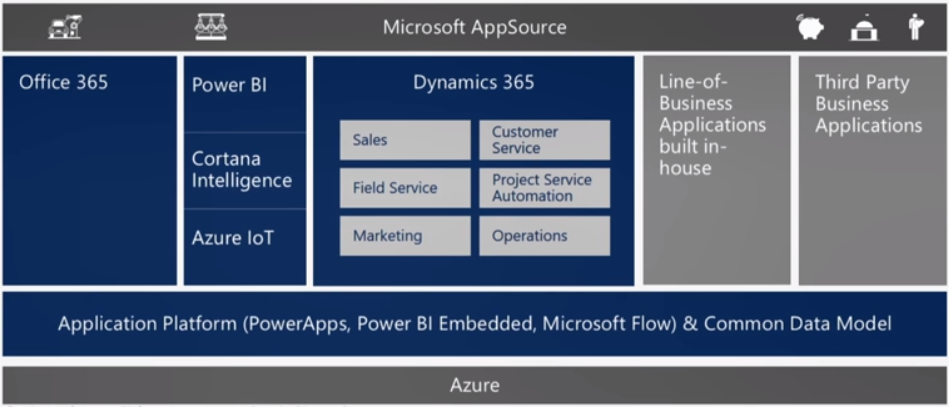
In those solutions, CDM can work in two main ways: as an Operational Data Store (ODS) for Dynamics 365, and as a Transaction-Processing Store (TPS). In the Operational Data Store model, you pull data from other systems so you can work on a composed version of that data. These other systems are typically multiple systems of record and are usually read-only. In the TPS model, data is represented by updatable entities (supporting read and write operations) and can be used for transaction-based data changes in CDM.
Enterprise Data Challenges
In a large enterprise, there are multiple data sources or feeds that compose the common dataset required for your business applications, workflows, or BI. A typical example is a customer record that needs to be shared across multiple legal entities (companies) within your business processes, apps, or analytics.
Many large international service-oriented organisations face this problem when implementing global finance or CRM solutions. There will often be cases where they have multiple legacy systems holding a set or subset of master data — such as customer or vendor records — in all sorts of different formats.
What is even more important is that these organisations typically want to sell services across all of their subsidiaries to the same customer, recording it under the same global project sub-ledger and making it transparent for consolidated corporate management reporting. Add to this the classic problem with pay-when-paid scenarios, which in some countries is a statutory requirement. These scenarios are much easier to handle with a common data model where your main master data — customers, vendors, and services — is shared across systems and legal entities.
Key Principles
The key principles of using CDM as a data model solution for these scenarios:
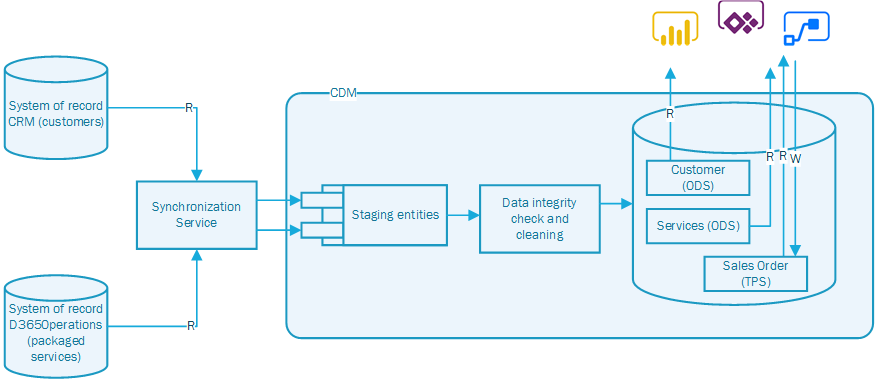
- Bulk and asynchronous synchronisation of data (in-flow of data from external systems)
- Transformation of external entity schemas into CDM entity schemas
- Usage of staging tables to detect duplicates and support other data cleansing processes
- Use of non-synchronised entities for reading and writing (Orders TPS)
- Read-only access from synchronised entities (Customers and Packaged Services ODS)
- Link entities as needed based on available keys
Technical Highlights
From a technical point of view, the following key points are worth highlighting:
- Staging entities and data integrity verification in CDM are built using technology similar to the DIXF (Data Import/Export Framework), which is already familiar to AX consultants and developers.
- Role-based security follows a model similar to AX security, with CRUD permissions at the entity, field, and record level, and easy opt-ins and opt-outs for test and development environments.
- The system of record can be Dynamics 365 for Operations, AX2012, Dynamics CRM, or any other external system.
- Dynamics 365 for Operations includes data management improvements — specifically, a new data source (connector) for CDM is available out of the box. Standard AX data management tools such as data projects can be used to export predefined entities directly into CDM, either manually or via an automated periodic batch job.
Social Listening and Service Insights
Another interesting example of utilising a CDM-based solution in service industries is social listening and service/product insights. With a growing number of connectors available for CDM, you can start ingesting data from a variety of social media feeds, telemetric equipment, field engineers, and other sources.
With all of this data, you can provide the business with much better insights into user feedback and customer satisfaction. That data can then be put into a financial perspective by adding costs and revenue, as well as an operational planning perspective by adding service/product types, categories, and hierarchies. Visualising all of this in a graph — broken down by each service or product's components and attributes — can help with planning and allocation of resources.
Conclusion
Building modern business applications with CDM and Dynamics 365 can bring a synergy of analytics, user experiences, and automation to any service-related industry.